

Key Insights for Every EV Owner
- Temperature is a silent culprit: Extreme heat significantly accelerates battery degradation. Parking in the shade and preconditioning are your best defenses.
- The 20-80% rule is golden: For daily driving, keeping your battery charge within 20% and 80% minimizes stress and prolongs its life.
- Slow and steady wins the race: Prioritize Level 2 (home/work) charging over frequent DC fast charging to reduce thermal stress on your battery.
Electric vehicles (EVs) are revolutionizing personal transportation, offering a cleaner, quieter, and often more dynamic driving experience. As a new EV owner, you're likely excited about the future of sustainable mobility. However, a common question often arises: "How long will my EV battery last?" The answer largely depends on understanding a phenomenon called EV battery degradation. This isn't a sudden failure, but a gradual reduction in the battery's ability to hold a full charge, which naturally impacts your vehicle's range over time.
The good news is that modern EV batteries are remarkably robust, often designed to outlast the vehicle itself. More importantly, your daily habits play a significant role in how quickly this degradation occurs. By adopting a few smart practices, you can dramatically slow down the aging process and ensure your EV maintains its optimal performance for many years and miles to come. This comprehensive guide will illuminate the primary causes of EV battery degradation and equip you with actionable strategies to safeguard your investment.
Decoding EV Battery Degradation: What's Happening Under the Hood?
At its core, EV battery degradation is a complex electrochemical process. Lithium-ion batteries, the workhorses of today's EVs, experience irreversible chemical changes over time and through use. These changes can reduce the total amount of energy the battery can store (capacity fade) and its ability to deliver power quickly (power fade). While some degradation is inevitable, understanding its mechanisms empowers you to mitigate its impact.
Imagine your EV battery as a sophisticated organ in your vehicle. Just like any organ, it responds to its environment and how it's treated. Factors like temperature, charging patterns, and driving style all influence the chemical reactions within the battery cells. These reactions can lead to the formation of unwanted byproducts, structural changes in the electrodes, and loss of active lithium, all contributing to a diminished capacity over time.
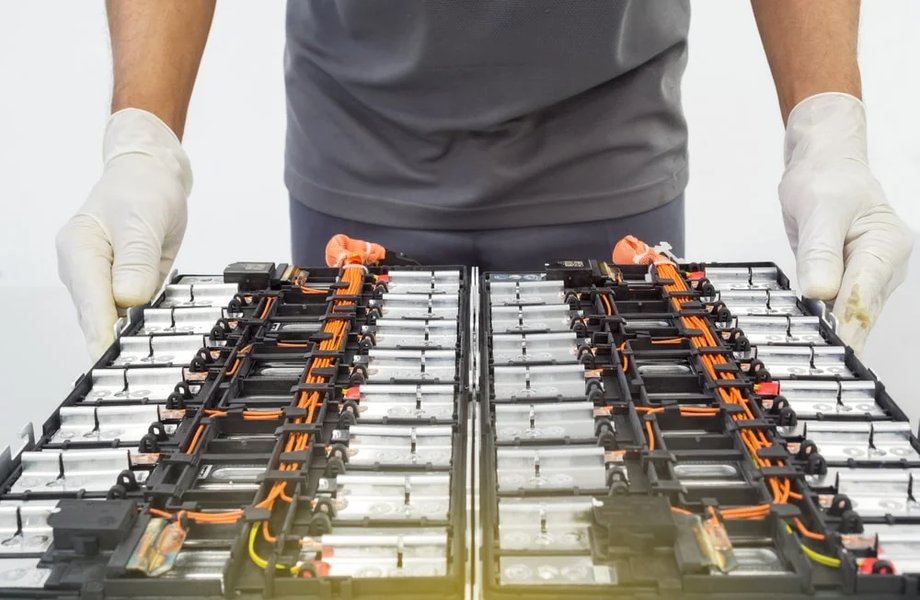
An illustration showing the internal structure of an EV battery module.
The Five Pillars of Battery Stress: Key Causes of Degradation
Extensive research and real-world data from millions of miles driven by EVs have identified several primary factors that accelerate battery degradation. Let's delve into each one, explaining why it matters and what you can do about it.
1. The Heat is On: Exposure to High Temperatures
Why heat is the enemy:
Heat is arguably the most significant accelerator of battery degradation. Elevated temperatures increase the rate of undesirable chemical reactions within the battery cells. Specifically, high temperatures can cause the electrolyte to break down and the solid-electrolyte interphase (SEI) layer on the anode to thicken. This impedes lithium-ion movement, leading to capacity loss.
Imagine a chemical reaction. Generally, the hotter it gets, the faster the reaction proceeds. This principle applies to the aging processes within your EV battery. Parking your car under the scorching sun for hours, operating it in consistently hot climates, or even charging it when the battery is already warm from a long drive, all contribute to thermal stress. Data from studies like Geotab's EV Battery Health Report show that EVs consistently operating in environments above 77°F (25°C) can degrade significantly faster than those in milder conditions.

A graphic illustrating various factors influencing EV battery life, with temperature often highlighted as a major one.
Your defense strategy:
- Seek shade: Whenever possible, park your EV in a garage or a shaded spot, especially on hot days. This simple act can dramatically reduce the battery's internal temperature.
- Preconditioning is key: Use your EV's scheduled departure feature or smartphone app to precondition the cabin (and battery) while the vehicle is still plugged in. This uses grid power to bring the battery to an optimal operating temperature before you start driving, minimizing strain.
- Mind your charge timing: Avoid fast charging immediately after a spirited drive on a hot day. Give the battery some time to cool down first. Similarly, charging during the cooler parts of the day (e.g., overnight) can be beneficial in hot climates.
2. The Charge Extremes: Overcharging and Deep Discharging
Why extremes are detrimental:
Lithium-ion batteries are most stable and happiest when their state of charge (SoC) is in the mid-range. Consistently keeping the battery at 100% or allowing it to frequently drop below 20% puts significant chemical stress on the cells. At very high states of charge, lithium ions are tightly packed, increasing internal resistance and accelerating unwanted side reactions. Conversely, at very low states of charge, certain battery components can undergo structural changes that lead to irreversible capacity loss.
The Geotab study reinforces this, noting that vehicles spending over 80% of their parked time at these extreme charge levels (either very high or very low) experienced accelerated degradation. It's not just about hitting 100% or 0% occasionally, but about making it a habitual parking state.
Finding the "Goldilocks Zone":
- Embrace the 20-80% rule: For daily driving, aim to keep your battery's charge level between 20% and 80%. This range provides enough practical utility while minimizing stress on the battery's chemistry. Many EVs allow you to set a charge limit, making this an easy habit to adopt.
- Charge to 100% only when necessary: If you need maximum range for a long trip, charging to 100% right before departure is perfectly fine. However, avoid letting the car sit at 100% SoC for extended periods. Drive it soon after it reaches full charge.
- Avoid prolonged low charge: Similarly, don't leave your EV parked for days with a very low state of charge. If you anticipate a period of inactivity, charge it to around 50-60%.
3. The Rush Hour: Frequent DC Fast Charging
The hidden cost of speed:
DC fast charging is an incredible convenience for road trips, allowing for rapid replenishment of energy. However, this speed comes at a potential cost to battery longevity. Fast charging involves pushing high currents into the battery, which generates significant internal heat. As we've established, heat is a primary driver of degradation.
While modern EVs are equipped with sophisticated battery management systems (BMS) that regulate charging speeds and temperatures, repeated exposure to high-power fast charging can still accelerate wear compared to slower charging methods. The Geotab study observed that vehicles using high-power DC fast chargers (over 100kW) for more than 12% of their charging sessions showed an average degradation rate of 3.0% per year, double the rate of those who rarely used them.
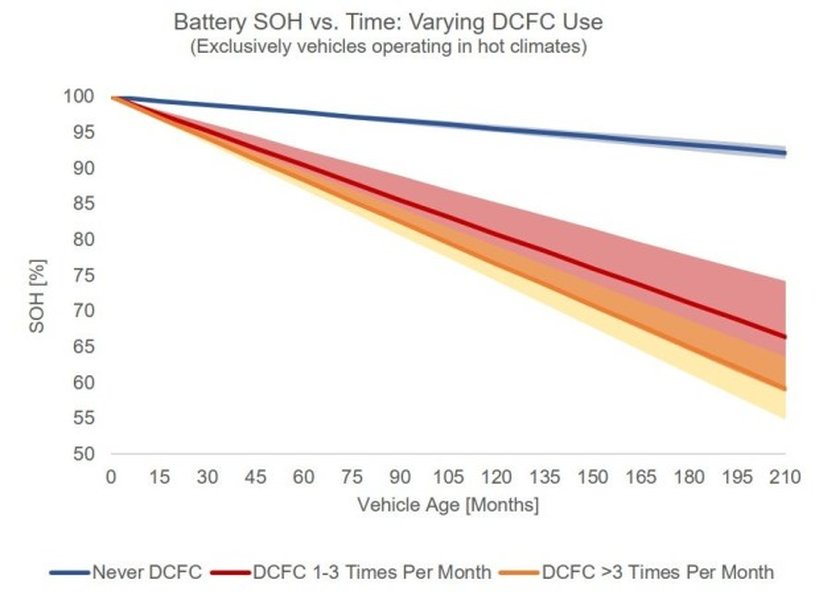
A chart demonstrating the impact of fast charging frequency on EV battery degradation.
Smart charging habits:
- Make slow charging your default: For daily needs, rely on Level 1 (standard wall outlet) or Level 2 (home or public AC charging station). These methods are much gentler on the battery and generate less heat.
- Reserve fast charging for necessity: Think of DC fast charging as a tool for long journeys or urgent top-ups, not your primary charging solution.
- Optimize fast charging sessions: When you do use a fast charger, aim to charge within the 10-70% or 15-80% range. Charging beyond 80% often sees a significant drop in charging speed as the BMS protects the battery, making the extra time less efficient for the added stress.
4. The Driving Dynamics: Aggressive Acceleration and Braking
How your foot affects your battery:
Your driving style has a direct impact on the demands placed on your EV battery. Frequent "jackrabbit" starts, hard acceleration, and sustained high-speed driving force the battery to deliver high currents in short, intense bursts. This rapid energy discharge and recharge (during regenerative braking) generates internal heat and puts significant strain on the battery's components, contributing to faster aging.
While EVs are designed for impressive performance, consistently pushing them to their limits can translate into more rapid battery degradation over time. Think of it as repeatedly asking your heart to run a sprint versus a marathon. Both are forms of exertion, but the intensity and duration matter for long-term health.
Cultivating a smoother ride:
- Embrace smooth acceleration: Ease onto the accelerator pedal rather than stomping on it. This not only preserves your battery but also improves your overall energy efficiency and range.
- Utilize regenerative braking: This feature captures kinetic energy during deceleration and sends it back to the battery. It reduces wear on your physical brakes and puts less strain on the battery than frequent hard acceleration followed by conventional braking.
- Maintain steady speeds: On highways, using cruise control helps maintain a consistent speed, minimizing power fluctuations and optimizing efficiency.
5. The Unstoppable March of Time: Calendar Aging
The inevitability of time:
Even if you hardly drive your EV, its battery will still experience "calendar aging." This refers to the natural, slow chemical degradation that occurs over time, regardless of use cycles. The chemical components within the battery inherently age and change, leading to a gradual loss of capacity. While you can't stop time, certain environmental factors can accelerate calendar aging.
Factors like constantly high states of charge and elevated temperatures, even when the car is parked, can exacerbate this natural aging process. This is why proper storage conditions are crucial if you plan to leave your EV unused for extended periods.
Mitigating time's impact:
- Drive regularly: Batteries benefit from regular, moderate use. If you anticipate not driving your EV for more than a month, consult your owner's manual for specific storage instructions.
- Store at a mid-level charge: If storing your EV for an extended period, aim for a charge level of around 50-60%. This is the most stable state for lithium-ion batteries during inactivity.
- Keep software updated: EV manufacturers frequently release over-the-air (OTA) software updates. These often include improvements to battery management algorithms, which can optimize charging, thermal management, and overall battery health.
A Side-by-Side Look: Charging Methods and Their Battery Impact
Understanding the different charging methods available for your EV and their respective impacts on battery health is crucial for making informed decisions. Below, we compare Level 1, Level 2, and DC Fast Charging.
Proactive Battery Care: Actionable Tips for New EV Owners
Now that you understand the main causes of EV battery degradation, let's translate that knowledge into simple, actionable steps you can integrate into your daily routine. Remember, modern EVs are designed with sophisticated Battery Management Systems (BMS) that actively work to protect your battery. Your role is to support these systems with good habits.
Mastering Your Charging Routine
Daily charging discipline:
- Set your daily charge limit: Most EVs allow you to set a target charge percentage. For daily driving, set this to 80% (or even 70% if your commute allows). This minimizes the time your battery spends at high states of charge.
- Plug in frequently: Instead of waiting for your battery to get very low, plug in whenever you have the opportunity, even if it's just for a short top-up. Shallow, frequent charges are better than deep, infrequent cycles.
- Utilize scheduled charging: Take advantage of your EV's ability to schedule charging sessions. This often allows you to charge during off-peak hours (potentially saving money) and can ensure the battery finishes charging just before your departure, reducing the time it sits at a high SoC.

A screenshot of an EV's charging interface, highlighting charge limit settings.
Driving Smarter for Longer Battery Life
Efficiency through mindful driving:
- Smooth acceleration and braking: As discussed, gentle inputs reduce stress. Think about anticipating traffic and coasting rather than abrupt stops and starts.
- Leverage regenerative braking: Maximize the use of your EV's regenerative braking. This not only recoups energy but also means less wear and tear on your friction brakes. Many EVs offer adjustable regen levels; experiment to find what works best for you.
- Maintain tire pressure: Properly inflated tires reduce rolling resistance, which means your battery doesn't have to work as hard to move the car. This directly impacts range and, indirectly, battery longevity by reducing the demand cycles.
Environmental Awareness: Temperature Management
Protecting against the elements:
- Park strategically: During hot weather, prioritize parking in the shade or a garage. In very cold weather, a garage can also help keep the battery within a more optimal temperature range.
- Precondition while plugged in: This is especially important in extreme temperatures. Cooling or heating the cabin (and battery) while connected to the grid uses external power instead of draining the battery, preparing it for optimal performance and reducing stress.
- Avoid charging a hot battery: If you've been driving aggressively or in very hot conditions, give the battery some time to cool down before initiating a charge, especially a fast charge.
Long-Term Storage Best Practices
Safeguarding your EV during inactivity:
- Maintain a mid-level charge: If you plan to store your EV for an extended period (weeks or months), ensure the battery is charged to approximately 50-60%. Consult your owner's manual for specific recommendations.
- Store in a cool environment: Whenever possible, store your EV in a cool, dry place, such as a garage, to minimize calendar aging caused by heat.
- Periodic check-ins: If storing for a very long time without a connected charger, periodically check the battery's state of charge and top it up to the recommended storage level if it drops significantly.
Understanding Your EV's Battery Warranty
Most electric vehicles come with substantial battery warranties, often guaranteeing that the battery will retain a certain percentage of its original capacity (commonly 70%) for 8 years or 100,000 miles (whichever comes first). This warranty provides a significant safety net for EV owners. While the tips above help you maximize your battery's health, it's reassuring to know that manufacturers stand behind their technology.
It's important to read and understand the specifics of your EV's battery warranty. This document outlines what is covered, under what conditions, and what actions might void the warranty. Knowing your warranty terms can provide peace of mind and help you make informed decisions about battery care.
Frequently Asked Questions About EV Battery Degradation
Conclusion: Empowering Your EV Journey
Electric vehicle battery degradation is a natural and expected part of owning an EV. However, it's not a process that happens uncontrollably. As a new EV owner, you hold significant power to influence the lifespan and performance of your battery. By understanding the core causes of degradation—extreme temperatures, habitual extreme states of charge, frequent fast charging, aggressive driving, and calendar aging—you can adopt simple yet highly effective habits.
The key takeaway is consistency: prioritize Level 2 charging for daily use, keep your battery between 20-80% for most situations, park mindfully to manage temperature, and drive smoothly. These small, deliberate actions compound over time, ensuring your EV battery remains healthy, your range stays robust, and your electric driving experience remains enjoyable for countless miles ahead. Your battery is a valuable asset; treat it well, and it will serve you faithfully on your sustainable journeys.
